VR Movement Setup Finder
Answer a few questions to find the most suitable way for you to move in virtual reality.
Recommended Method:
Quick Takeaways: How VR Movement Works
- Room-Scale: Walking physically within a limited, cleared area.
- Artificial Locomotion: Using a joystick to move while standing still.
- Omnidirectional Treadmills: Hardware that lets you walk infinitely in any direction.
- Redirected Walking: A clever trick using visuals to make you walk in circles without knowing it.
The Basics of Room-Scale VR
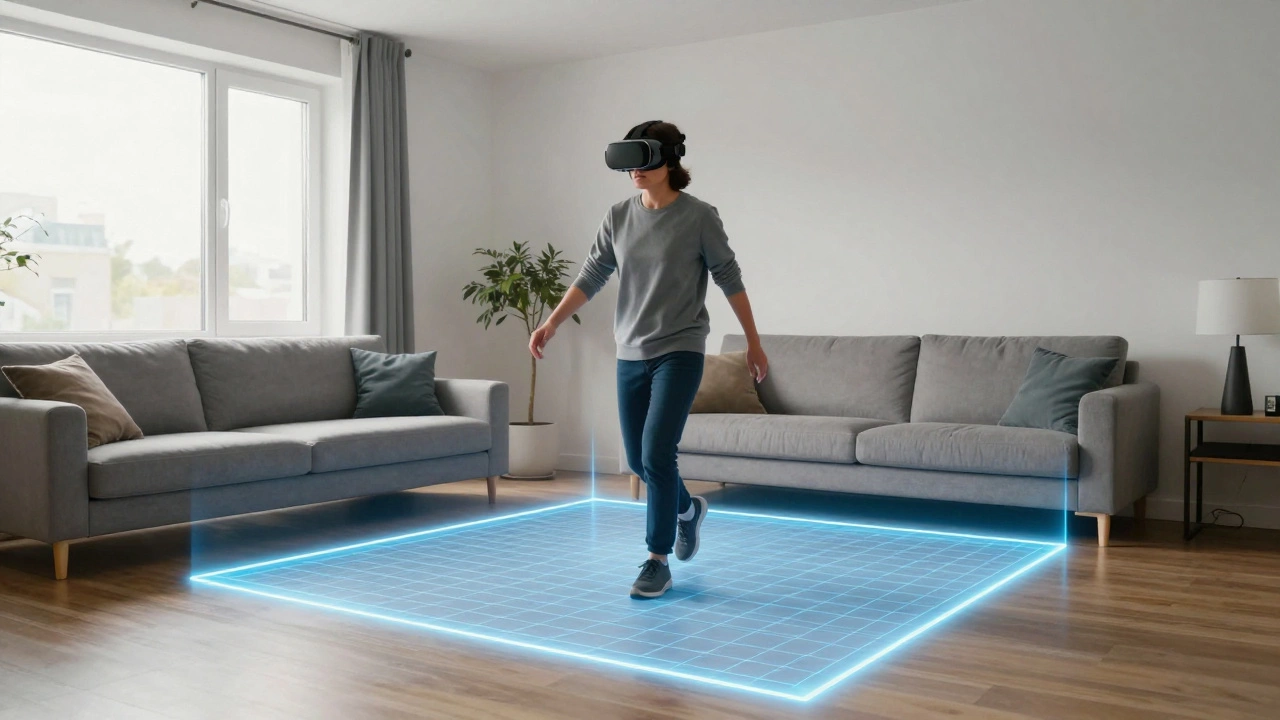
Most people start with Room-Scale VR is a setup where the user defines a safe physical boundary, allowing them to move naturally within that space. If you have a 3x3 meter area cleared of furniture, you can physically walk to a door or dodge a projectile in a game. This is the most intuitive form of movement because your inner ear and your eyes are agreeing on what is happening. When you take a step, your brain registers the movement, and the digital world shifts accordingly.
However, the "wall problem" is real. You can't walk a mile in a game if your room is only ten feet wide. This is where Guardian System is a virtual boundary seen through the headset that warns users when they are nearing the edge of their play area comes into play. Whether you use a Meta Quest or a Valve Index, these boundaries prevent you from punching your TV or stepping on a sleeping dog. But once you hit that virtual wall, the immersive experience usually breaks.
The Struggle with Artificial Locomotion
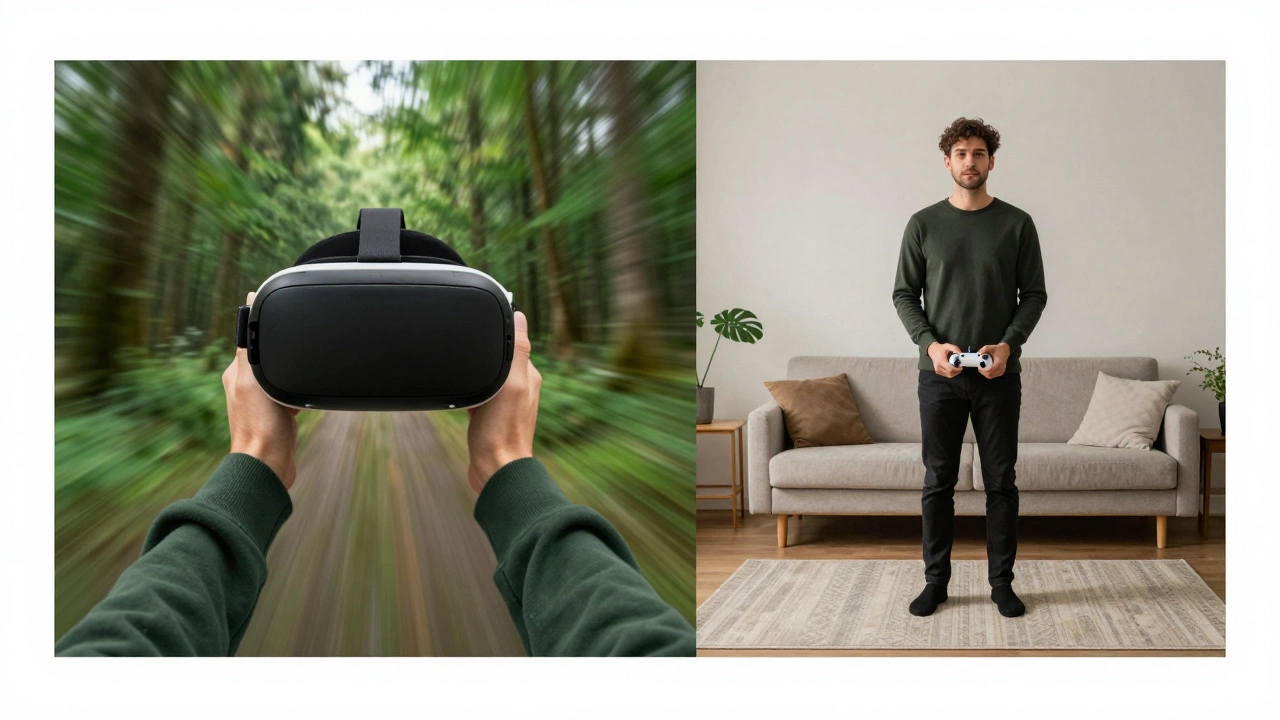
Since most of us don't live in aircraft hangars, developers created artificial locomotion. This is when you use a Thumbstick to slide your character across the map. While convenient, this is the primary cause of motion sickness. Why? Because of a sensory mismatch. Your eyes tell your brain you are sprinting through a forest, but your vestibular system (the balance center in your inner ear) tells your brain you are standing perfectly still in your bedroom. This conflict often leads to nausea, cold sweats, and dizziness.
To fix this, many games use "vignetting," which narrows your field of view during movement to reduce the peripheral motion that triggers nausea. Some players prefer "teleportation," where you point to a spot and instantly blink there. It's not as "realistic" as walking, but it's a lifesaver for those who get sick easily.
Walking Forever: Omnidirectional Treadmills
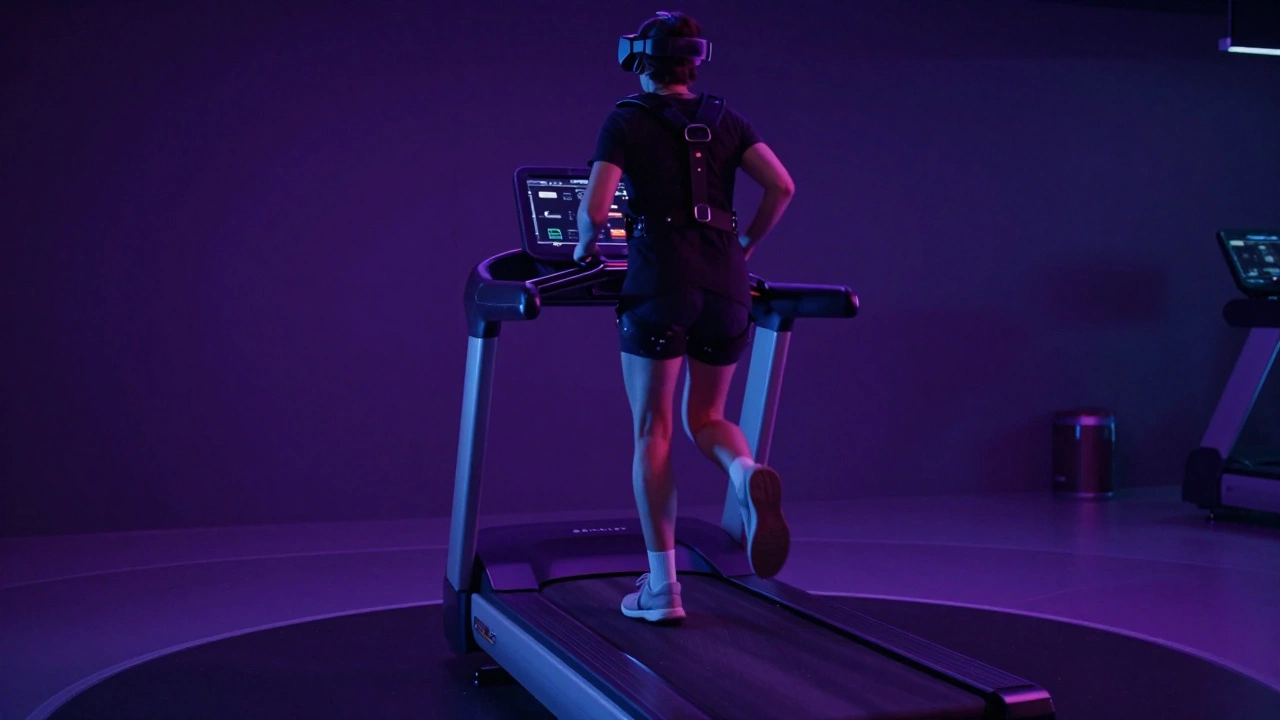
If you want to actually walk for miles without leaving your room, you need a Omnidirectional Treadmill is a specialized hardware platform that allows a user to walk in any direction on a fixed surface by slipping or rotating the user back to center. These devices, like those made by Virtuix, use a low-friction surface or a rotating disk to keep you centered. You walk forward, and the machine subtly slides you back to the middle, creating the illusion of infinite travel.
These aren't exactly consumer-friendly yet. They are loud, expensive, and often require a harness so you don't fly off the platform during a sudden turn. However, in high-end VR arcades, these are the gold standard for immersion. Instead of pushing a stick, you physically stride, making the experience feel less like a video game and more like a simulation.
| Method | Physical Effort | Sickness Risk | Equipment Cost | Immersion Level |
|---|---|---|---|---|
| Room-Scale | Medium | Very Low | Low | High |
| Joystick Locomotion | None | High | None | Low |
| Treadmills | High | Low | Very High | Maximum |
| Teleportation | None | None | None | Medium |
The Magic of Redirected Walking
There is a high-tech trick called Redirected Walking is a technique that subtly alters the visual environment to lead a user in a circle while they believe they are walking in a straight line. It relies on the fact that humans aren't perfect at sensing exact angles when they are distracted by an immersive environment. By slightly rotating the map as you walk, the software tricks you into turning a corner in the real world while you think you're still heading straight.
This is mostly used in professional installations or museum exhibits. It allows people to explore a massive digital city without needing a treadmill or a giant warehouse. If the curve is subtle enough, you can walk in a large circle in your room and feel like you've traversed a long hallway. It's a brilliant bridge between the physical and digital worlds.
Tips for a Better Walking Experience
If you're new to moving in VR, jumping straight into a fast-paced shooter can be a mistake. Your "VR legs"-your brain's ability to handle sensory mismatch-take time to develop. Start with stationary experiences, then move to teleportation, and gradually try joystick movement in short bursts. If you start feeling a tiny bit dizzy, stop immediately. Trying to "power through" motion sickness usually makes the feeling last for hours after you've taken the headset off.
Another pro tip is to use a physical fan. Having a constant breeze on your face provides a directional cue that helps your brain ground itself in the real world, which significantly reduces the feeling of vertigo during artificial movement.
The Future of Physicality in VR
We are moving toward a world where Haptic Feedback is the use of vibrations, forces, or motions to communicate information to the user's sense of touch will be integrated into the floor. Imagine a floor that can tilt or vibrate when you step on gravel versus metal. While we aren't at the point of a "Ready Player One" omni-directional treadmill in every home, the gap is closing. The goal is to remove the "boundary' entirely, making the physical space irrelevant to the digital journey.
Do I need a special room to walk in VR?
Not necessarily, but you need a clear space. For basic room-scale movement, a 2x2 or 3x3 meter area free of furniture is ideal. If you have a very small room, you can still use VR by relying on teleportation or joystick movement, though you won't be physically walking.
Why do I feel sick when I move in VR but not when I walk in real life?
This happens because of a sensory conflict. When you walk in real life, your eyes and your inner ear agree. In VR, if you use a joystick to move, your eyes see movement, but your inner ear feels stillness. This mismatch triggers a response in the brain similar to motion sickness in a car.
Are VR treadmills worth the money for home users?
Currently, they are mostly for enthusiasts or commercial venues. They are very expensive and take up a lot of space. For most people, a well-cleared room and "VR legs" are a more practical solution.
Can I walk in VR without a headset?
No, by definition, virtual reality requires a Head-Mounted Display (HMD) to immerse your vision in the digital world. Without it, you're just playing a standard video game on a screen.
How can I prevent motion sickness while walking in VR?
Use teleportation mode if available, enable vignetting (the black border during movement), keep a fan blowing on you, and take frequent breaks. Never force yourself to continue if you feel nauseous.